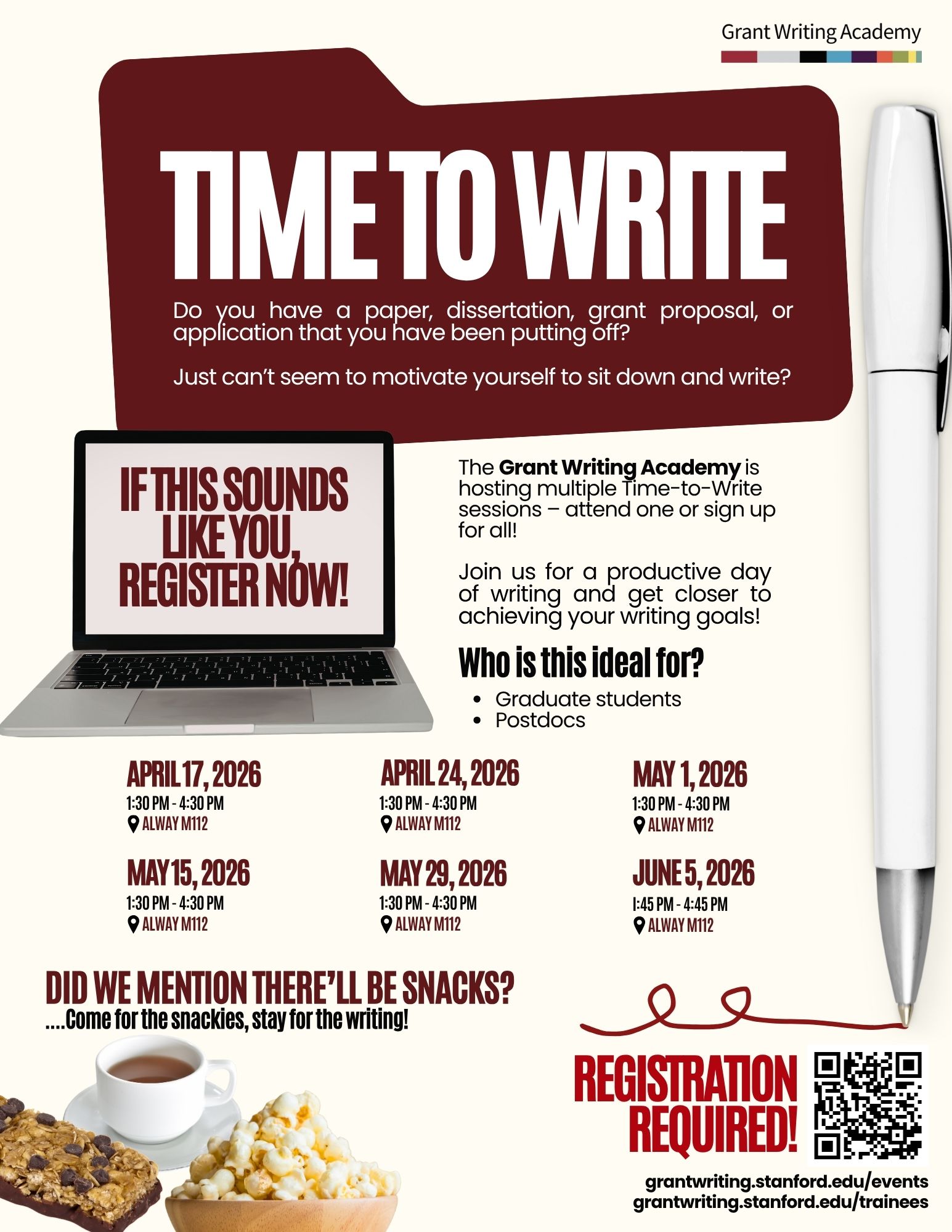
Time-to-Write: May 29
- Graduate Students
- Postdocs
REGISTRATION REQUIRED!
Do you have a paper, dissertation, grant proposal, or application you’ve been putting off? Or maybe you’re finding it hard to motivate yourself to sit down and write?
On May 29, the Grant Writing Academy is hosting the fifth of six Time-to-Write Sessions for Stanford graduate students and postdocs. Join us for a focused block of writing time in a supportive environment—light snacks provided!
Download our flyer and share with your friends!
Note: This session runs from 1:30 PM – 4:30 PM and requires participants to attend the full session. Please register only if you can stay for the entire time.
What to Expect
During the session, you’ll complete four 25-minute writing blocks using the Pomodoro technique. Participants will be placed in small groups of 2–4 students or fellows. At the start of each block, you’ll briefly share your writing goal with your group. At the end of the block, you’ll do a quick check-in to reflect on your progress and set your next goal.
How to Prepare
Please bring a fully charged laptop or whatever materials you prefer to write with. If possible, review any relevant literature and have your references ready in advance. Preparing a brief outline ahead of time can also help you make the most of the session.
We’re looking forward to a productive afternoon of focused writing and helping you move closer to your writing goals.
To help us improve future sessions, we’ll also invite attendees to share feedback on the timing and format of upcoming Time-to-Write events.
Questions? Please contact the Instructors: Dr. Cameron Bader or Dr. Antonio Tomasso.
About the Instructors:
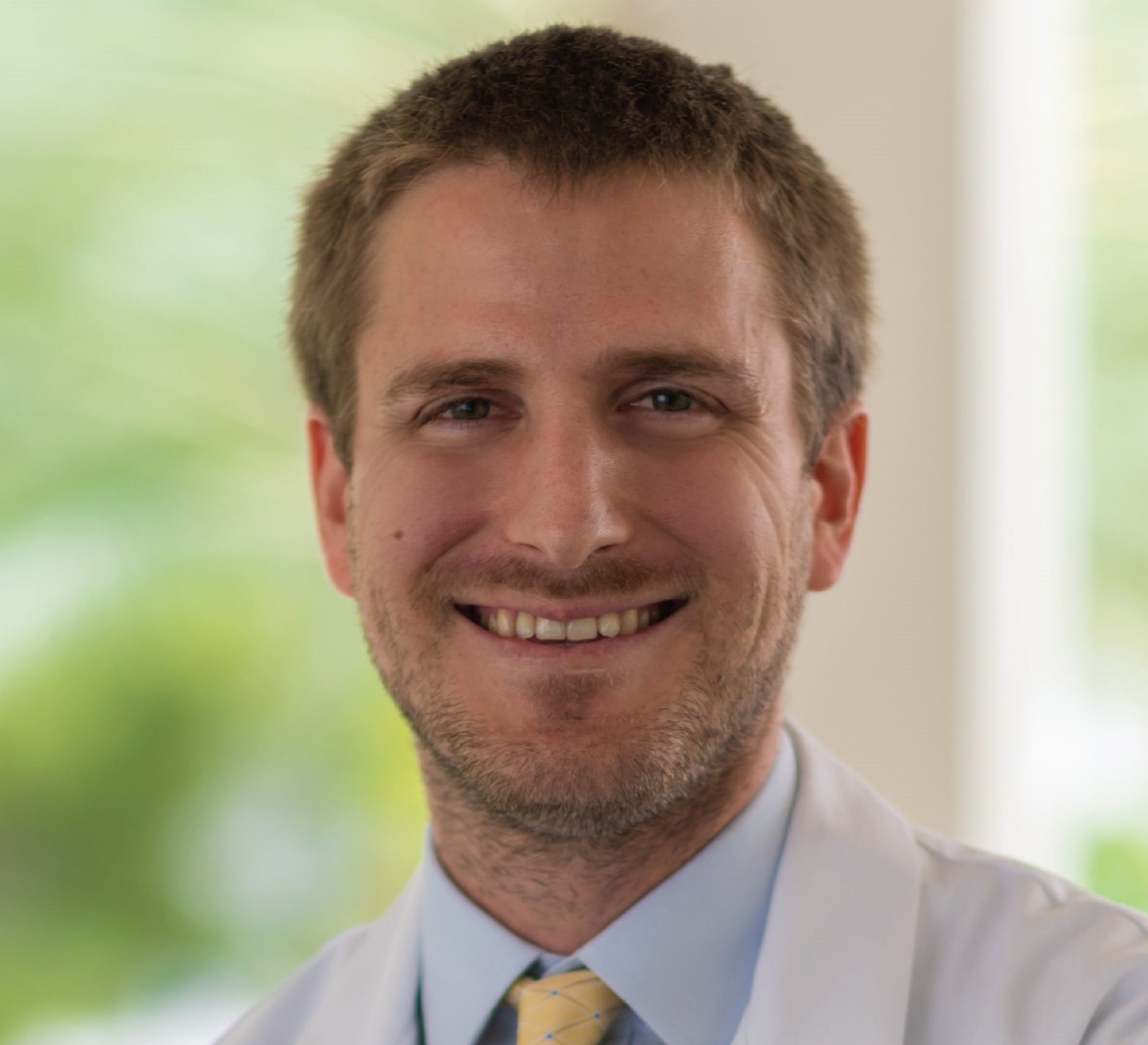
Dr. Cameron Bader is a postdoctoral scholar and immunologist in the Division of Blood and Marrow Transplantation at Stanford University. His graduate studies investigated the role of the innate immune sensor STING in murine models of graft-versus-host disease and bone marrow transplantation. In his postdoctoral training, he has continued to investigate novel strategies to augment hematopoietic cell transplantation as a cure for cancer, to improve solid organ transplantation, and to prevent neurodegenerative disease with animal models and bioinformatic approaches in humans. Cameron has been the recipient of NIH F31 and F99/K00 fellowships and is now funded by a K99/R00 career development award which will support his transition to an independent tenure-track faculty position. Cameron is passionate about mentorship and teaching and is excited to apply his experience towards developing novel tools to help prospective grant writers identify required documents, develop a timeline, and track progress towards their targeted grant mechanism. Outside of science, Cameron enjoys spending time with his wife, dogs (Max and Izzy), and experimenting with new ingredients in the kitchen.
Dr. Antonio Tomasso is postdoctoral scholar at Stanford Medicine – Department of Surgery. He is a recipient of the NWO/Dutch Research Council Rubicon grant and the Horizon Europe Marie Skłodowska-Curie Actions (MSCA) Global Fellowship, investigating the cellular and molecular drivers of tissue regeneration and fibrosis. His ultimate goal is to identify therapeutic targets enhancing organ and tissue repair after injury or disease. He earned his BSc and a MSc in Medical and Molecular Biotechnology from Vita-Salute San Raffaele University in Milan, and a PhD in Cellular and Molecular Life Sciences at the Max Planck Institute for Molecular Biomedicine in Germany. Having conducted research across five countries, including at the Karolinska Institute, University of Kentucky and Hubrecht Institute, he brings a deep foundation in regenerative medicine, molecular biology and translational research. He has gained extensive experience writing and securing competitive grants and has developed a practical toolbox of strategies for navigating the challenges of grant applications. As a Grant Coach, he is committed to sharing what he has learned, best practices and common pitfalls to help students and postdocs strengthen their applications, particularly for international grants, and achieve their professional goals. Beyond the lab, he enjoys hiking, ballroom and bachata, working out and exploring Bay area cafes in search of the best espresso.
If you need a disability related accommodation to participate in this event (captioning, sign language interpreting, Braille, etc.), please contact the Diversity & Access Office at disability.access@stanford.edu or 650.725.0326. Requests should be received at least one week prior to the event.