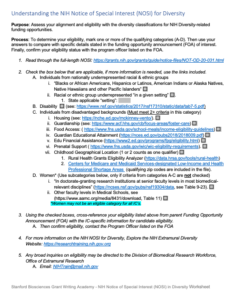
To support diverse postdocs to develop their independent research skills through a two-phase program: an initial mentored research experience followed by a period of independent research. For help determining your congruence with the NIH classifications for Diversity, please see the Grant Writing Academy’s NOSI for Diversity Worksheet (click here to download) for more information.
Notable Differences in MOSAIC K99/R00 ATTACHMENTS:
Diversity Statement: A description of the individual’s commitment to diversity in the biomedical sciences that includes:
Any past or present leadership, mentoring and outreach activities to enhance diversity – especially involving groups underrepresented in the biomedical research enterprise
Planned activities during the career award to develop or enhance skills in working effectively with talented scientists from a wide variety of backgrounds and to promote inclusive and equitable scientific biomedical research environments.
Description of the Candidate’s Contribution to Program Goals (Formerly Candidate Eligibility Statement): The sponsoring institution must provide a document on institutional letterhead that explains how the candidate’s participation will further the goals of the career development program to promote diversity in health-related research.
Notable Differences in MOSAIC K99/R00 Construction:
Candidate Section:
Rationale for first time application in fourth year
Description of how the activities provided by the MOSAIC Institutionally-Focused Research Education Award (UE5) will be integrated into career development activities
Mentor
Biosketch:
Address record of maintaining a record of training in rigorous and unbiased experimental design;
Efforts taken to enhance diversity in the biomedical research workforce, and to ensure the research environment is inclusive, safe, and supportive for trainees from all backgrounds;
Commitment to fulfilling the need of the trainees to complete their training in a timely fashion with the skills, credentials and experiences to transition into independent careers in the biomedical research workforce.
Plans: Must describe their willingness to participate in conferences organized by the MOSAIC UE5 cohorts to exchange ideas and employ evidence-based approaches to enhance diversity and improve mentoring relationships
Institutional Environment (Extended to 2-page limit):
Institutional career development resources and activities that will be available to contribute to the candidate’s career development (e.g., an office of postdoctoral affairs, a seminar series for future faculty, etc.).
Institutional policies and practices that are expected to contribute to the candidate’s research and career development success, such as
promote diversity and inclusion in the research training environment,
ensure that the institution’s facilities are accessible to those with disabilities,
foster a positive, supportive, and safe research and training environment
prevent discriminatory harassment and other discriminatory practices and to appropriately respond to allegations of such discriminatory practices
Resources:
Highlighted Resources for MOSAIC K99/R00:
Watch and reference the slides for the 2020 MOSAIC K99/R00 Webinar
To understand the types of activities provided by each UE5 participating organization, please navigate to the webpages for each UE5 participating organizations.
For a general overview of NIH Diversity Awards programs checkout, the UNLISTED Intersection Fellows 2020 Webinar on “Unlocking the Secrets of NIH Funding- Learning the Ins and Outs”
This discussion by panelists associated with NIH regarding funding opportunities for postdoctoral fellows (including the parent K99/R00, the MOSAIC K99/R00, the BRAIN K99/R00, Early-Stage investigators awards, and Diversity Supplements).
Dr. Kenneth Gibbs speaking about the K99/R00 awards starts at 5.26
Please note that the NIH Diversity Supplements can be used as “bridge funding” between initial postdoctoral funding and applying to the MOSAIC K99/R00 programs.
Relevant resources from the Grant Writing Academy: